
Health Anxiety A.K.A. "Why Can't I Stop Googling My Symptoms?" Disorder
It’s 2 a.m. and you’re sitting upright in bed, the bright glare of your phone screen cutting through the darkness of your bedroom as you’re frantically scrolling through Reddit. Outside, the city hums on. You’re exhausted and anxious, wanting nothing more than to go to sleep. Instead, you’re again neck-deep in an internet rabbit hole, reading the story of a perfectly healthy person suddenly receiving a devastating medical diagnosis. “How did I end up here AGAIN? I don’t want to be reading this!” And yet you click on the next link, helpless and horrified as you repeat the pattern of researching, checking, and reassurance-seeking you’ve engaged in countless nights before, with no end in sight…
If this sounds familiar, you’re likely experiencing what is known colloquially as health anxiety. It provides clinicians and patients shared language for understanding health-related distress. And while “health anxiety” communicates someone’s worry about their health very effectively, the term is a blunt instrument. Usefully recognizable, but lacking in nuance and diagnostic precision.
Health anxiety was historically associated with a diagnosis called hypochondriasis: a term often used dismissively in everyday conversation. For those suffering from constant worry and anxiety about their well-being, being labeled a “hypochondriac” can feel invalidating—as if their distress is overblown or not worthy of attention.
With the 2013 publication of the DSM-5, hypochondriasis was retired as a diagnosis and replaced in many cases by Illness Anxiety Disorder and Somatic Symptom Disorder. These diagnoses provide clarity and guidance to both patients and clinicians when discussing health-related fears.
Illness Anxiety Disorder
Illness anxiety is marked by significant, persistent fear or anxiety about having or developing a serious illness, despite few or no actual symptoms being present. In these cases, individuals will consistently worry about having a debilitating or terminal condition, and go to exhausting lengths to “make sure” that they’re okay. In some instances, these fears can extend to the health of loved ones, which adds to the worry. Our brains constantly monitor for any changes in physical functioning to try to make sure we (or those we care about) are safe. Even seemingly minor changes can hijack our attention and trigger intense warning signals.
Involuntary eye twitch? Might be a stroke!
Shortness of breath? Could be lung cancer!
Slightly darker urine? Kidney failure!
Now imagine our 2 a.m. Reddit scroller, whose restful night was quickly turned into one of anxiety, worry, and frantic reassurance-seeking. The culprit? Brushing their teeth and noticing their gums feeling a bit more sensitive than usual. While the symptom may seem minor, the potential catastrophe certainly does not. The possibility of something serious feels impossible to ignore. And thus, the painful search for safety and certainty begins again.
To make things even more difficult, triggers aren’t just physical. An overheard comment, a spouse’s coughing, an ad for medication, health-related news stories… anything health-related can trigger illness anxiety and lead to a painful cycle of rumination, checking, and reassurance-seeking. For some, the anxiety and prospect of a serious illness is so distressing that they forgo any medical care whatsoever for fear of being diagnosed with something catastrophic. This avoidance creates reluctance to seek appropriate medical care when needed, and can lead to additional health concerns.
Somatic Symptom Disorder
With this diagnosis, individuals have consistent physical symptoms that can range from stomach issues and muscle pain to headaches and fatigue. These symptoms, whether they have known medical explanations or not, can persist for months or years. These symptoms are real and can be deeply distressing. Somatic Symptom Disorder involves physical symptoms that are accompanied by excessive worry thoughts, anxiety, and behaviors related to them, which cause significant disruptions in daily life.
For our 2 a.m. Reddit scroller—imagine they didn’t pay any attention to their gums, because they’ve been experiencing persistent dizziness for over six months and are feeling a bit unsteady at the bathroom sink. The dizziness is uncomfortable, it’s scary, and it shows up constantly. Despite evaluations, medical guidance, and hours of research, the dizziness keeps pulling them back into a loop of fear and worry about their health and their future. So there they are, lying in bed, replaying the day’s episodes. “Why am I still dizzy? Why can’t anyone explain it? Is there something wrong with me? What if it never goes away? What if I can’t take care of my kids, or travel, or work?”
And the distress doesn’t always disappear when the dizziness wanes. Even when the symptom subsides, apprehension about its return—and what it might mean for their future, can linger. It’s the symptom itself, and the fear and uncertainty surrounding it, that consume valuable time, energy, and attention day after day.
So whether it be the fear of a serious illness, or the fear of persisting physical symptoms leading to catastrophe, both fears are related to our health and well-being. And because our anxious brains have such difficulty tolerating uncertainty, they will push us to exhaustion and despair to confirm we’re 100% okay; something we can never know for sure.
A self-perpetuating cycle
When my patients first start telling me they’re anxious, I’ll ask them: “Well, how do you know you’re anxious?”
After giving me an understandably strange look, they’ll list off a range of symptoms:
“I get nauseated”
“I can feel my heart pounding”
“I start hyperventilating”
These can feel really scary!
One of the painful aspects of health anxiety is that it can reinforce itself. Anxiety about physical sensations triggers physical sensations of anxiety. The symptoms of the disorder can perpetuate it. Individuals with health anxiety are often keenly aware of their own physiological sensations because it's in these sensations that the threat to their safety resides. What would otherwise pass unnoticed becomes a sign of potential danger.
Checking, Googling, and reassurance-seeking can offer short-term relief, and medical visits are part of maintaining one’s health. But when visits are driven by the need for reassurance they become part of the anxiety cycle. You feel reassured and the anxiety dissipates—but when the reassurance wears off and doubt reemerges, your brain remembers what seemed to help last time, and urges you to check again. Over time, it’s hard to do anything but focus on making the anxiety go away; suffering in this cycle for the sake of safety.
Here’s how the anxiety cycle can keep going:
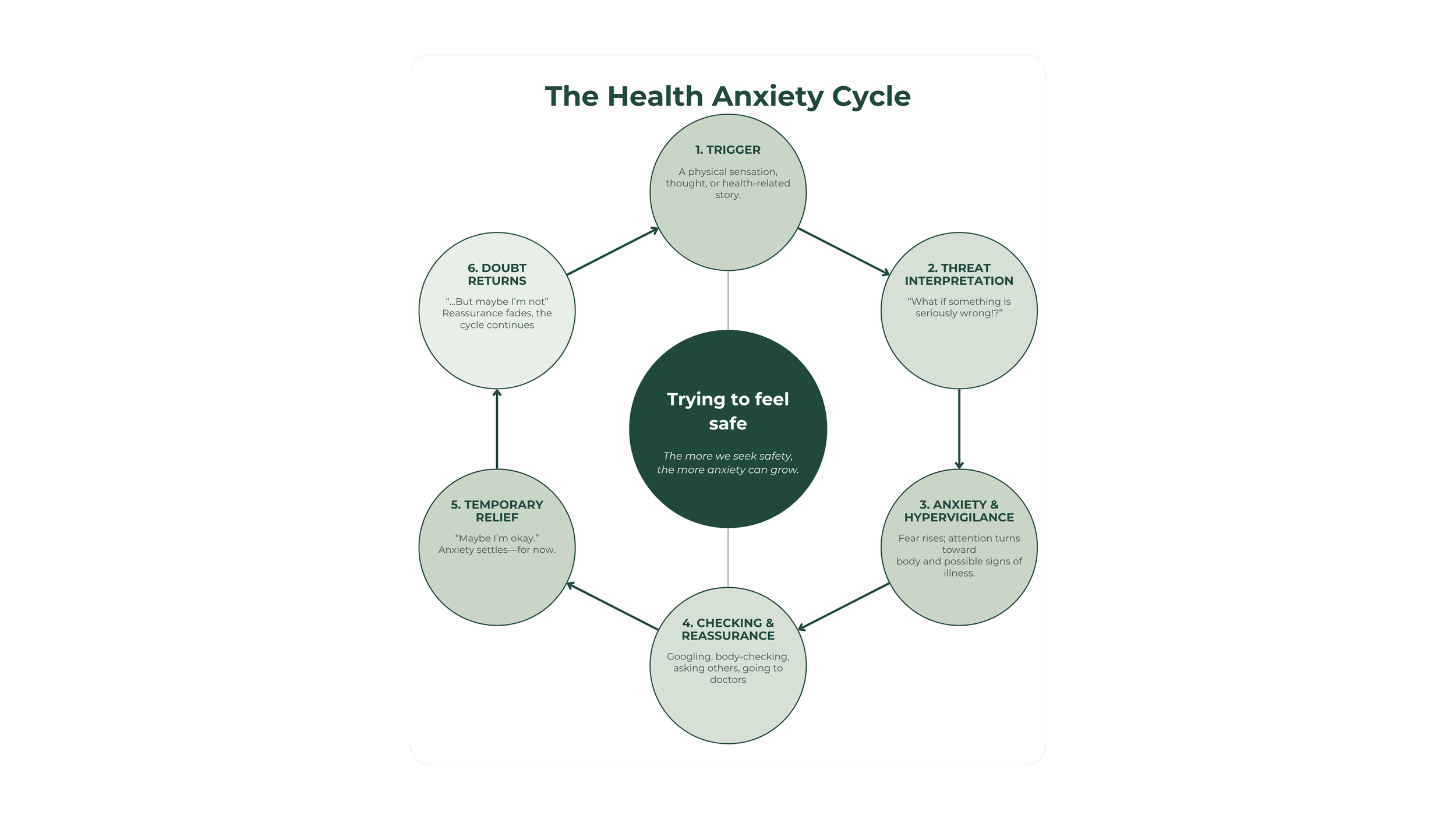
The cycle can look different for everyone, but the underlying pattern is ubiquitous
So What is One to Do?
When health anxiety takes hold, it feels as though the only way to be okay is to never get sick, never have unexplained symptoms, and maintain perfect health. A tall order, and a rather unrealistic one.
Instead, through thoughtful collaboration with a trained therapist, you can learn to recognize health-related triggers, the painful thoughts they generate, and the behaviors that keep you stuck. Over time, you can develop ways to stay in the driver’s seat and keep anxiety from dominating your life.
Cognitive Behavioral Therapy (CBT), including Exposure and Response Prevention (ERP) when appropriate, can help you respond differently to uncertainty, reduce unhelpful checking and reassurance-seeking, and reclaim what brings you fulfillment and value.
The goal isn’t to stop caring about your health, ignore concerning symptoms, or stop engaging in appropriate medical care. The goal is to change your relationship with health-related fears so that you’re no longer ruled by uncertainty.
You deserve to spend less time protecting yourself from life, and more time living it.
